
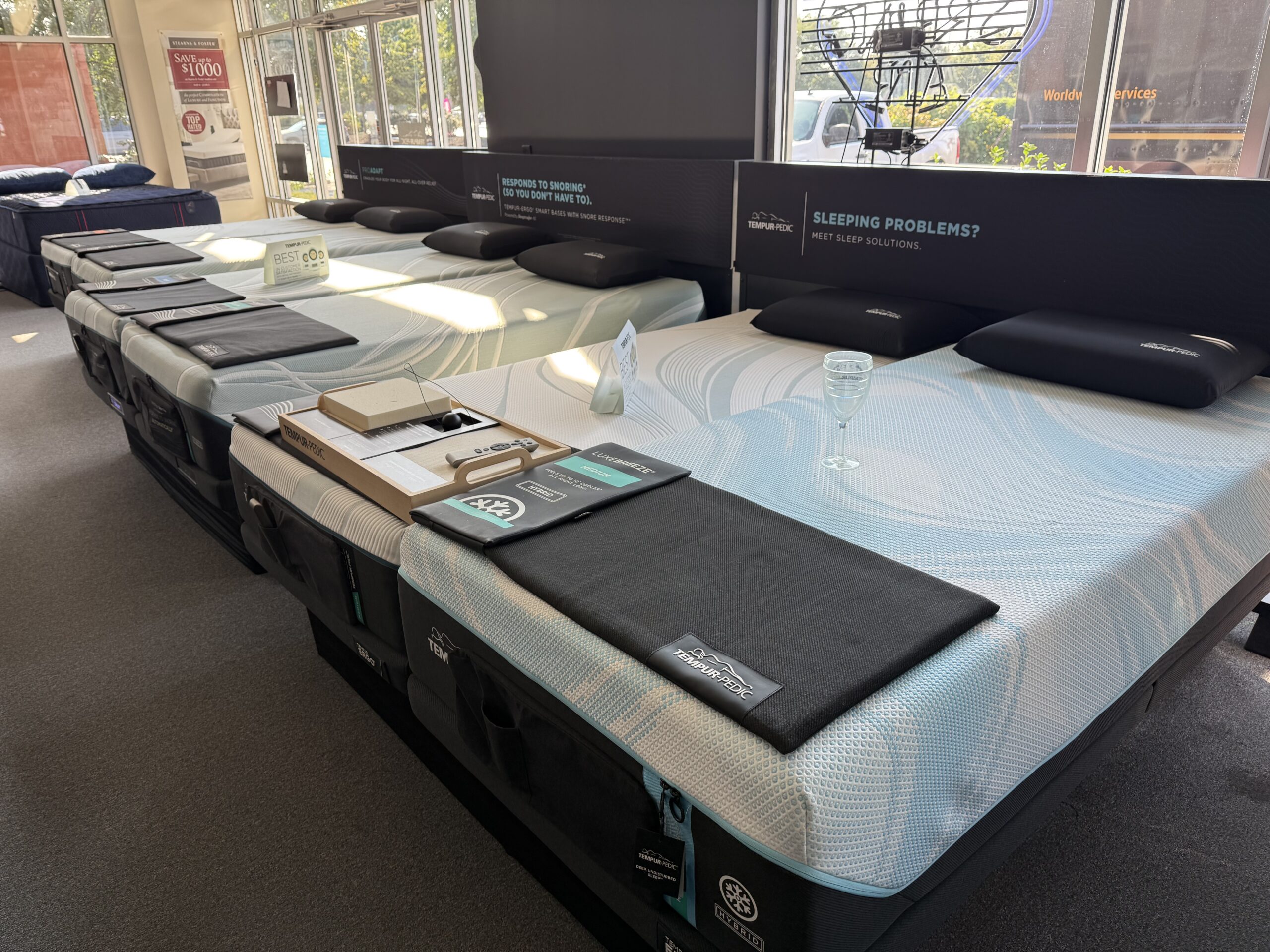
TEMPUR-Pedic is one of the most recognizable names in the mattress industry, but what actually makes a TEMPUR-Pedic mattress feel different?
Is it simply another memory foam mattress?
Why does the material respond differently when you lie on it?
What creates the slow, conforming sensation TEMPUR-Pedic is known for?
And what changes when you move from a traditional TEMPUR-Pedic mattress to a hybrid or one of the company’s cooling-focused models?
For consumers researching TEMPUR-Pedic mattresses in Nashville and Middle Tennessee, understanding the technology can be more useful than immediately trying to decide which model to buy.
Let’s take a closer look at what’s happening underneath you when you lie on a TEMPUR-Pedic.
What Is TEMPUR Material?
The defining component of a TEMPUR-Pedic mattress is proprietary TEMPUR® material. https://www.tempurpedic.com/
The history behind the technology traces back to NASA research involving pressure-absorbing materials. The technology was later adapted and further developed for sleep products, eventually becoming the foundation of the TEMPUR brand.
Although TEMPUR material is frequently grouped into the broad category of memory foam, shoppers shouldn’t assume every memory foam mattress will feel the same.
Foams can differ considerably in formulation, density, responsiveness, durability and how they react to pressure and temperature.
TEMPUR material has a particularly recognizable characteristic:
It gradually conforms around the body rather than immediately bouncing back against it.
Lie down on a traditional spring mattress and you may immediately feel the mattress pushing upward.
TEMPUR material produces a different sensation.
As your body settles into the surface, the material adapts around your shape.
That’s where much of the recognizable TEMPUR-Pedic feel comes from.
What Does “Pressure Relief” Actually Mean?
“Pressure relief” is one of the most frequently used phrases in mattress advertising.
But what does it actually mean?
When you lie down, your body weight isn’t distributed perfectly evenly across the mattress.
Certain areas carry considerably more pressure.
For a side sleeper, two obvious examples are the:
Shoulders and hips.
For a back sleeper, the relationship between the hips, lumbar region and upper body becomes particularly important.
A pressure-relieving material attempts to conform around these areas rather than creating concentrated resistance directly against them.
Imagine pressing your fist into a very rigid surface.
The surface barely changes shape, so most of the force remains concentrated around the relatively small contact area.
Now imagine pressing your fist into a material capable of gradually conforming around it.
More of your fist becomes supported.
The force is distributed across a larger area.
That’s a simplified way of understanding the principle behind conforming mattress materials.
Why Side Sleepers Often Pay Attention to Pressure Relief
Side sleeping places a relatively large amount of body weight onto relatively small contact areas.
Your shoulder needs somewhere to go.
So does your hip.
If the surface doesn’t accommodate those areas sufficiently, some sleepers may experience uncomfortable pressure.
However, simply making a mattress extremely soft isn’t necessarily the solution.
You still need an appropriate balance between comfort and support.
That’s why mattress feel is so personal.
A mattress that provides excellent pressure relief for one person may feel too firm or too soft to somebody with a different body weight, shape or sleeping position.
Why Does TEMPUR-Pedic Feel So Different From Traditional Foam?
This is something that’s easier to understand when experienced in person.
Push your hand firmly into TEMPUR material and remove it.
Instead of immediately snapping back like some conventional cushioning materials, TEMPUR material tends to recover more gradually.
That slower response contributes to the “hugging” or conforming sensation associated with TEMPUR-Pedic.
Some sleepers love that feeling.
Others prefer a more buoyant or responsive surface.
Neither preference is wrong.
Mattress comfort is subjective.
That’s also why buying a mattress based exclusively on specifications can be difficult.
You can understand exactly what a material is designed to do and still need to experience it to know whether you enjoy sleeping on it.
What Is Motion Isolation?
Pressure relief isn’t the only reason TEMPUR material became popular.
Another important characteristic is motion absorption.
Imagine two people sharing a mattress.
One person rolls over.
Gets out of bed.
Returns to bed.
Changes sleeping positions.
On some traditional interconnected spring systems, that movement can travel through the mattress.
A highly motion-absorbing comfort material can reduce how much of that movement reaches the other sleeper.
This characteristic can make TEMPUR-Pedic particularly interesting for couples.
You can perform a very simple test when mattress shopping.
Have one person lie still on one side of the mattress.
Have the other person change positions or get in and out of bed.
How much movement does the stationary sleeper notice?
That’s more useful than simply reading the phrase “motion isolation” on a product description.
Is TEMPUR-Pedic the Same as Regular Memory Foam?
Not exactly.
TEMPUR material belongs to the broader family of viscoelastic cushioning technologies, but TEMPUR-Pedic uses proprietary formulations and constructions.
It’s also important to recognize how much variation exists within the general category consumers call “memory foam.”
Two mattresses can both say “memory foam” on the label while feeling completely different.
Thickness can differ.
Density can differ.
Formulations can differ.
Supporting layers underneath the memory foam can differ.
The construction beneath the comfort layer can dramatically change how the finished mattress performs.
That’s why comparing mattresses solely by whether they contain “memory foam” doesn’t tell the entire story.
Why Does the Support System Underneath the Foam Matter?
The top comfort layers get most of the attention in mattress advertising.
But what’s underneath them matters too.
Think of the mattress as a complete system.
The upper materials interact directly with the body and help determine initial comfort and pressure distribution.
The deeper support system helps control how far the sleeper settles into the mattress and contributes to overall stability.
Different TEMPUR-Pedic models can approach this support structure differently.
Some use an all-foam construction.
Others use a hybrid design with individually wrapped coils.
That distinction can noticeably change the overall feel.
TEMPUR-Pedic Foam vs Hybrid: What’s the Difference?
A hybrid mattress combines comfort materials with a coil support system.
In a TEMPUR-Pedic hybrid, the sleeper still experiences TEMPUR material in the comfort system, but underneath it is a system of individually wrapped coils.
The word individually matters.
Unlike a traditional interconnected spring unit in which springs are mechanically connected, wrapped coils are designed to respond more independently.
That can allow the support system to contour more closely to different areas of the body while providing a different degree of responsiveness.
The result is an interesting combination:
TEMPUR material above + wrapped coils below.
Some sleepers strongly prefer the traditional TEMPUR feel of an all-foam construction.
Others like having the response of coils underneath them.
There isn’t a universal winner.
This is a preference worth testing.
What About Lumbar Support?
“Lumbar support” is another mattress phrase that can become oversimplified.
The goal isn’t necessarily to make the middle of every mattress extremely firm.
The human body has curves.
A mattress has to accommodate those curves while providing an appropriate level of overall support for the individual sleeper.
For a back sleeper, pay attention to how your hips settle into the mattress and how the surface interacts with your lower back.
For a side sleeper, the relationship between the shoulder, waist and hip becomes particularly important.
The right balance depends partly on the sleeper.
Body weight matters.
Body proportions matter.
Sleeping position matters.
Personal comfort preference matters.
That’s why one mattress cannot reasonably be expected to feel identical to everybody.
Why Do Some People Think Memory Foam Sleeps Hot?
Temperature is another important part of the conversation.
Traditional memory foam has sometimes been associated with sleeping warm.
One reason is the conforming sensation itself.
If a sleeper sinks farther into a mattress, more of the body can be surrounded by material compared with sleeping on top of a highly buoyant surface.
That’s one reason modern mattress manufacturers have invested heavily in temperature-management technology.
TEMPUR-Pedic is no exception.
Depending on the collection, TEMPUR-Pedic uses different combinations of covers, materials and temperature-management technologies.
The company’s Breeze collections place particular emphasis on cooling.
How Does TEMPUR-Pedic Cooling Technology Work?
It’s helpful to separate two ideas:
Cool-to-the-touch sensation and overnight temperature management.
A mattress cover can feel cool when you first touch it.
That’s an immediate sensation.
Longer-term temperature management involves how the complete sleep system handles heat as the night progresses.
Some TEMPUR-Pedic collections incorporate phase-change materials and other temperature-management components designed to absorb and manage excess heat.
Cooling-focused Breeze models take this concept further.
However, no mattress exists in isolation.
Your sheets matter.
Your mattress protector matters.
Your blankets matter.
Room temperature matters.
Humidity matters.
Even what you wear to bed can influence thermal comfort.
So if you’re a hot sleeper, don’t evaluate a mattress based solely on the word “cooling.”
Experience it when possible and evaluate your entire sleep environment.
Why Does TEMPUR-Pedic Have So Many Collections?
Once you understand the underlying concepts, the TEMPUR-Pedic lineup becomes easier to understand.
Rather than thinking:
Good → Better → Best
think:
Different combinations of technology and comfort.
TEMPUR-Adapt provides an introduction to the classic TEMPUR experience.
TEMPUR-ProAdapt introduces more advanced pressure-relieving technology and additional construction choices, including hybrid options.
TEMPUR-LuxeAdapt moves farther into premium pressure-relieving materials.
TEMPUR-Breeze collections put substantially greater emphasis on temperature management.
But the important takeaway isn’t memorizing a product hierarchy.
It’s understanding what each technology is attempting to accomplish.
Then you can decide which characteristics actually matter to you.
A Simple TEMPUR-Pedic Test Anyone Can Perform
If you’re researching TEMPUR-Pedic in person, don’t simply walk through a showroom and sit on the corner of several mattresses.
Perform an actual sleep test.
Start by lying in your normal sleeping position.
Then give the material time to respond.
Test 1: Shoulder Pressure
If you’re a side sleeper, pay particular attention to your shoulder.
Does the material comfortably accommodate it?
Test 2: Hip Pressure
Notice how your hips settle into the mattress.
Do you feel excessive concentrated pressure?
Test 3: Lower-Back Comfort
Roll onto your back.
Pay attention to the relationship between your hips and lumbar area.
Test 4: Movement
Change positions several times.
Do you like the slower conforming sensation, or would you prefer something more responsive?
Test 5: Motion Isolation
If you’re shopping with a partner, have one person remain still while the other moves.
Test 6: Foam vs Hybrid
If both constructions are available, compare them back-to-back.
Don’t assume you’ll prefer one simply because of what you’ve read online.
Don’t Confuse Firmness With Support
This deserves special attention.
Firmness and support aren’t exactly the same thing.
Firmness describes the sensation you experience when interacting with the mattress.
Support relates to how effectively the complete mattress system maintains and accommodates your body.
A very firm mattress isn’t automatically more supportive for every sleeper.
Likewise, a softer comfort layer doesn’t automatically mean the mattress lacks underlying support.
Mattress construction is a system.
The comfort layers and support structure work together.
This is another reason consumers should be cautious about making decisions based exclusively on words such as:
“Soft.”
“Medium.”
“Firm.”
Those descriptions are useful starting points.
They’re not substitutes for experiencing the mattress.
Should You Try TEMPUR-Pedic Before Buying?
When possible, there’s a strong practical argument for doing so.
Mattresses are unusually personal products.
You can research materials for weeks and still discover that your body prefers something different than you expected.
If you’re researching TEMPUR-Pedic in Nashville, Murfreesboro, Franklin, Smyrna or the surrounding Middle Tennessee area, consider visiting a showroom specifically for research.
You don’t necessarily have to purchase anything.
Compare TEMPUR material with conventional mattress materials.
Compare different comfort levels.
Compare foam with hybrid construction.
If temperature is important, compare cooling-focused models.
Spend enough time lying down for the material to begin conforming around your body.
Then decide what you actually like.
Understanding TEMPUR-Pedic Makes Shopping Easier
TEMPUR-Pedic doesn’t have to be complicated.
Once you understand a few basic concepts, the technology becomes much easier to evaluate:
TEMPUR material is designed to conform around the sleeper.
Pressure relief involves distributing force across a larger area rather than concentrating it around prominent pressure points.
Motion isolation can help reduce the amount of partner movement transmitted across the sleep surface.
Hybrid construction combines TEMPUR comfort materials with individually wrapped coils.
Cooling technology attempts to manage temperature while maintaining the pressure-relieving characteristics of the mattress.
And different TEMPUR-Pedic collections combine these technologies in different ways.
The most important thing to remember is that mattress technology should serve the sleeper—not the other way around.
Learn what the materials do.
Understand what you’re paying for.
Experience different constructions when possible.
Then allow your own comfort preferences to play a major role in the decision.
That’s ultimately far more useful than choosing a mattress simply because someone on the internet declared it “the best.”